

What is a Dental Bridge?
As the name suggests, a dental bridge will fill the gap created by a missing tooth. Traditional bridges are tooth-supported.
The teeth on either side of the gap, called abutment teeth, are reshaped so dental caps can be placed over them. These crowns hold the replacement tooth, called a pontic, between them.
Many of these restorations are single-tooth bridges. A one-tooth bridge consists of a single pontic supported by two abutment crowns. This is actually a three-unit bridge, since it has two abutment crowns and one pontic.
A traditional bridge can support more than one missing tooth if they were originally adjacent to each other. The restoration is permanently bonded in place and cannot be removed.
Dental bridges can last for years with the right aftercare.
Why is It Important to Replace Missing Teeth?
There are many reasons why it’s important to replace missing teeth, even if the gap isn’t visible in your mouth. These reasons include:
- Preventing adjacent teeth from shifting position.
- Preventing opposing teeth from moving out of place.
- Restoring correct bite alignment.
- Improving and protecting your ability to bite, chew, and speak.
- Supporting your facial features, especially if you lose multiple teeth and need a long span bridge.
A beautifully designed bridge can help improve aesthetics, boosting self-confidence and self-esteem.
Types of Bridges
Several types of bridges are available, depending on the position of the teeth requiring replacement and the health of the abutment teeth. Options include:
- Traditional dental bridges.
- Cantilever bridges.
- Maryland bonded bridges.
- Implant-supported bridges.
- Traditional Dental Bridges
A traditional bridge is the most common type, as it is strong and stable. It requires a healthy abutment tooth on either side of the gap. These teeth must be strong enough to support the bridge and withstand the additional forces generated during biting and chewing.
- Cantilever Bridges
These bridges are used when abutment teeth are only available on one side of the gap. In this situation, the abutment tooth would be crowned so the pontic, or replacement tooth, can be cantilevered from the crown. The other side of the bridge has no support.
A cantilever bridge can be a good solution when replacing front teeth that come under less significant forces during eating. It may be less suitable for replacing larger back teeth used for chewing, which are therefore under substantial pressure.
In some circumstances, we may recommend crowning two adjacent abutment teeth to support a cantilevered pontic. This would help provide extra support and strength.
- Maryland Bonded Bridges
A Maryland bridge is a bit different, as it uses wings fitted to the inner surfaces of the abutment teeth instead of crowns. The wings are then bonded onto the inner tooth surfaces.
We only use this type of bridge when replacing smaller front teeth, as they are significantly weaker than a traditional or cantilever bridge that uses crowns for support. Sometimes, a Maryland bridge can pop off or become unbonded. In this situation, it’s important to come back to Dental Pearl so we can clean the bridge and re-bond it to your teeth.
- Implant-Supported Bridges
Natural teeth do not support these bridges, so the process of making and fitting them is quite different. Instead, they are supported by dental implants surgically inserted into your jawbone, which replicate a natural tooth root.
An implant-supported bridge can be a useful solution if you don’t have natural teeth strong enough to support a bridge, or if you are missing all your own teeth.
You can find more information about dental implants and implant-supported bridges on the dedicated webpages.
Who Is a Good Candidate for a Dental Bridge?
Suitable candidates include people who:
- Are missing one or more teeth that were originally adjacent to each other.
- Have healthy teeth available for support, or are prepared to get dental implants.
- Have reasonable dental health.
- Prefer a non-removable solution for replacing missing teeth.
If you are missing one or more teeth, a dental bridge may be an effective way to restore your smile and improve your ability to chew comfortably. At Dental Pearl in North Miami Beach, our team can evaluate your oral health, discuss your tooth replacement options, and help you determine whether a traditional or implant-supported dental bridge is right for you.
Benefits of Dental Bridges
Benefits of choosing a dental bridge can include:
- A natural-looking appearance, as we design and contour all our bridges to look like real teeth.
- Improved biting and chewing function that is similar to real teeth.
- Protecting existing teeth from shifting position.
- A long-lasting treatment; dental bridges typically last 10 years or more, provided you care for them properly.
Dental bridges that are supported by natural teeth are relatively quick and non-invasive to make and fit. Implant-supported bridges do require a short surgical procedure and take slightly longer to complete.
Patient Experience
The Dental Bridge Procedure
Different bridges require different procedures for making and fitting them. If you are interested in the procedure to have an implant-supported bridge, it’s best to refer to the specific pages for this treatment, where you will find much more detailed information.
Dental Bridge Procedure for a Traditional or Cantilever Bridge
- Consultation and Examination
Our dentist at Dental Pearl will need to examine your mouth to assess your oral health and determine whether a tooth-supported bridge is the best option. This evaluation will likely include Digital dental X-rays, and we can discuss suitable bridge types available.
During this appointment, your custom treatment plan is created, detailing the time required to complete it and the cost, based on your choice of bridge and the materials used to create it.
- Tooth Preparation
Before we prepare your teeth, we numb them thoroughly using local anesthesia. It’s extremely important to us that our patients remain comfortable and relaxed during treatment, and we will check regularly to ensure you are okay.
Our dentist will carefully shape the abutment teeth, removing only enough material to create sufficient space for the dental crowns.
- Digital Dental Impressions
Once your teeth are prepared, we take a digital dental impression using a small handheld scanner. Digital impressions are much more precise and far more comfortable than an old-fashioned tray impression. Also, our dentist can check the impression on screen immediately to ensure it is perfect and ready to send to our dental lab.
- Temporary Restoration
It can take 2 weeks or longer to make your new bridge, so you will have a temporary restoration to protect the prepared teeth. This should look good and feel reasonably comfortable, but your permanent restoration will look amazing.
- Final Bridge Placement
When your new bridge is ready, we remove your temporary restoration and try it in your mouth to ensure it fits perfectly and looks good. We will make any necessary small adjustments before permanently cementing it in place.
Dental Bridge Procedure for a Maryland Bridge
- Consultation and Examination
You will need a consultation and dental exam, just as you would for a traditional bridge. Our dentist will take a digital dental X-ray to check that the abutment teeth are healthy enough for a Maryland bridge. You will receive a custom treatment plan, showing the price of your bridge and the proposed materials for fabricating it.
- Digital Dental Impression
A Maryland bridge requires minimal or no tooth preparation, so you will likely only need a digital dental impression and no local anesthesia. If you wish, you can receive a temporary restoration at this point while your Maryland bridge is custom-made.
- Final Bridge Placement
Once your new bridge is ready, you return to our dental office, and we prepare the inner surfaces of the abutment teeth by lightly etching them with a special fluid. Etching them creates a slightly rougher surface, enhancing the bond between your Maryland bridge and your natural teeth.
Your bridge is tried in, and any adjustments are made before it is permanently bonded onto the inner surfaces of your teeth.
Follow-Up Care Instructions
After receiving your new bridge, our dentist or hygienist will instruct you on proper care. Clean around the bridge on abutment teeth and beneath each pontic. Regular maintenance ensures longevity and protects surrounding teeth from decay. If your bridge is damaged, professional denture repair may be necessary. Full & partial dentures can also be integrated into your oral care plan if needed.
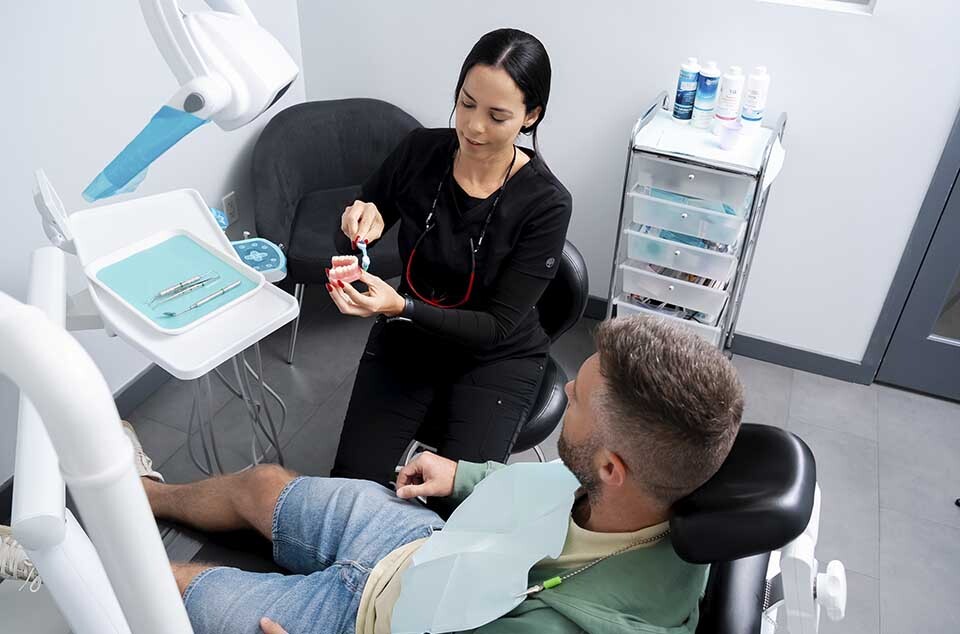
Our hygienist can discuss suitable tools, such as floss threaders, a WaterPik, or interdental brushes. They will show you exactly how to thoroughly clean your bridge.
Your oral care routine shouldn’t take very long, but it is important to protect your bridge and your natural teeth, and it will help prolong the life of your new restoration.
It’s also important to treat your bridge gently. Although it will allow you to eat just about anything you wish, avoid foods that are especially hard and which could break your bridge. Also, avoid habits like chewing on ice, your nails, or pencils, as these could crack your new bridge.
If a food or oral habit can damage natural teeth, it can also damage a dental bridge.
Dental bridges restore missing teeth to improve chewing, speech, and the appearance of your smile. At Dental Pearl Miami in North Miami Beach, FL, we provide custom‑designed bridges tailored to your needs for lasting comfort and function. Schedule your dentist appointment today to fill the gap and enhance your smile.
Frequently Asked Questions
How Long Will My Dental Bridge Last?
You can reasonably expect your dental bridge to last at least 10 years, provided you clean around it thoroughly every day and attend regular dental exams and hygiene appointments. Some dental bridges last much longer, but eventually you will need to replace this restoration.
How Many Teeth Can a Dental Bridge Replace?
We can provide dental bridges large enough to replace several missing teeth. The exact number will depend on whether you have enough natural teeth that are suitable for support.
Alternatively, we can discuss using dental implants to support your bridge. An implant-supported bridge can replace an entire arch of teeth.
Is Getting a Bridge Painful?
Receiving any dental appliances should never feel painful. When preparing your teeth, we always make sure they are thoroughly numb, blocking any unpleasant sensations.
However, after you first receive your bridge, you may notice your teeth feel a bit more sensitive. The sensation is perfectly normal, and your teeth should quickly settle down.
14771 Biscayne Blvd.,
North Miami Beach, FL 33181
(305) 816-6620
Updated on by Dr. Ella Dekhtyar, DDS (Cosmetic & Family Dentist) of Dental Pearl Miami